Showing posts with label Plato. Show all posts

Monday, March 11, 2013

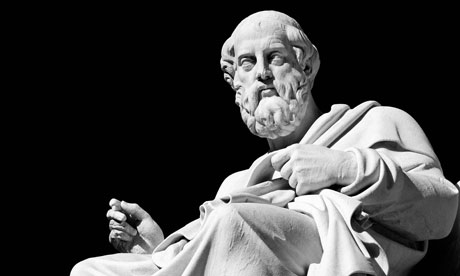
Quote of the Week - Plato on Electing Men to Public Office

“In politics we presume that everyone who knows how to get votes knows how to administer a city or a state. When we are ill... we do not ask for the handsomest physician, or the most eloquent one.”
 

― Plato

Wednesday, February 20, 2013

Was Socrates Guilty?

Having read Plato's Apology I want to ask myself the question: was Socrates guilty? Obviously, being a lover of freedom and a hater of tyranny I at first say that Socrates was not guilty. The man expressed his natural right of freedom: to talk about the important things in life with his peers and to question their convictions. Is that a crime? Is that something to be put to death over? Well, after thinking some more about it, I came to my answer from my classical liberal mindset which is the incorrect mindset to have when reading a work like the Apology. It's a big mistake. So, I put myself in the time and place of Socrates. After doing that then the answer is different. My understanding is that Socrates was guilty of corrupting the youth and of impiety.

My short take on this is that Socrates corrupted the youth. I need to ask a few questions first: what is corrupting the youth? If one means that Socrates, through his method of conversation, corrupted the youth by showing the statesman of the time and the sophists to be fools then yes Socrates corrupted the youth. Did Socrates make fools out of the statesmen? From the historical accounts of Socrates' life we see that time and again through his conversations with statesmen, sophists, and elders he brings these people into accepting contradictions and tears down their convictions quite easily and humorously thereby making them look foolish to Socrates' students. Is that corrupting the youth? Well, it is corrupting, at least to the government at the time, because Socrates is influencing young men who may one day be statesmen with his philosophy; a philosophy that is different from the political philosophy of that time; a teaching that makes the government look foolish. This can be taken as corruption to the youth. If this is corruption then Socrates is clearly guilty.

Another charge against Socrates is one of impiety. Is Socrates guilty of this? I think it's reasonable to say that Socrates is guilty of this. He brings up the Delphic Quest to possibly show that he isn't impious to the gods, that he isn't an atheist, but the shiny nugget nested underneath the apparent piety in the Delphic story is Socrates. What I mean is that it seems Socrates is the hero of the apparent pious story instead of piety because he had to take this quest and test the oracle, or the god, instead of taking the god at the god's word. Through his testing, a.k.a "reason," Socrates found to be true what the oracle told him and then he submitted to the oracle. He didn't take the pious route which would have been to blindly listen to the oracle, instead he took the route of reason, the impious route and through reason found the oracle to be true. That isn't pious. What if reason had shown the oracle to be false? I'm persuaded Socrates would have stood by reason instead of the god. The Delphic Quest is a story of the triumph of reason and shows Socrates was more interested in the things of man than in the things of the gods which isn't pious, but is impious.

These two things stood out to me when I reflected on the Apology. Currently, I'm persuaded to think that under the law of his time Socrates was truly guilty because of the reasons above: by their definition of corruption Socrates did corrupt their youth and Socrates wasn't a pious man.

Obviously, this post cannot contain the amount of thought that can be put into this situation so if you have any thoughts pleas comment below.

Monday, January 7, 2013

Quote of the Week - Plato on Tyrants

The people have always some champion whom they set over them and nurse into greatness. ...This and no other is the root from which a tyrant springs; when he first appears he is a protector. 565-C

When the tyrant has disposed of foreign enemies by conquest or treaty, and there is nothing to fear from them, then he is always stirring up some war or other, in order that the people may require a leader. 566-E

- Plato, The Republic, Book VIII, pg. 565-C 566-E

Friday, September 14, 2012

Do objective moral values just exist?

Do objective moral values just exist? Are they just "out there" existing with no foundation? Is there a moral realm full of objective values? Is rape wrong because it just is? Is loyalty good because it just is? These are questions I intend to answer in this blog post. This is something I've been throwing around in my mind the past few weeks.

Philosophers have been doing moral philosophy for a long time, a very long time, without appealing to God or gods for the foundation. I understand Plato to have grounded his moral philosophy in what he called "forms" or "ideas." Plato thought our observable world to be a defect of the real thing, a flawed image of a most beautiful painting. He thought we can observe beautiful things here in our world, like a painting, and call it "beauty," but it's not true beauty. This is the crux of Plato's philosophy: how he distinguishes between observable beauty (continuing with the beauty example) and what beauty really is (the form or idea that is "out there") which is how the observable objects receive the quality of beauty. It's very interesting. So that's one way of grounding morality without appealing to God. What are some others? Well, there's the moral philosophy of the greatest outcome for the greatest number of people. There's another grounded in human flourishing, and another that says there is no ground that morality differs from person to person so it's all relative. The most interesting one is the thought that objective moral values are "just there." The philosopher or person who says that mercy is good because it just is or rape is wrong because it just is. I've never heard of or read a solid name for it, maybe atheistic moral realism would be a solid label for it, anyway the idea is in the previous sentence that these moral values are objective because they just are. How nice. 

What do we make of this? Does it make sense that objective moral values just exist? Let's go ahead and cede to that for the moment. Okay. Objective moral values just exist. What does that mean for me as an individual? I'm an advanced primate. I'm experiencing the world around me. Do I encounter patience? Do I encounter justice? What tool do I use to mine for these values? Do I sense an oughtness or shouldness to follow these values if I do encounter them? I don't think so. On naturalism, if objective moral values exist it would be non-natural, that is abstract, and I have no reason to believe that we could know of them or should know them, i.e. that we would have an oughtness to know them as we do today. On naturalism I find it hard to believe that these unexplainable objective moral values existed unchanging during the whole process of evolution, not dependent on anything for their survival and somehow man became aware of these moral values and found out what they are? If naturalistic evolution is true and objective moral values do indeed "just exist" I find it very hard to believe that man would evolve in that perfect way as to be able to know what those moral values are. Given that scenario, it's as if the moral realm "knew" that just such a man was coming. It's as if man was rigged to know the moral realm, care about it, and follow its values; like there was a design or something. Strange. Of course, a non-natural moral realm cannot be personal because it's impersonal. In order for man to know about such abstract objects, it would have be personal. The theist is in a fine position to say that if God exists, then as a personal being He could choose to let man know of His existence by divine revelation and/or by letting his existence be known via reason, those human beings who are functioning properly. God is personal therefore knowable, whereas non-natural moral values/a moral realm is impersonal therefore unknowable.


It seems to me that the atheist who says moral values are illusory is in a much better position given naturalism because such a moral philosophy makes sense in a purely naturalistic world. I don't understand at all how non-natural moral values can exist in a purely naturalistic world. The atheistic moral realist may say, "Okay, fine. I can understand that point. If we must go further in attempting to ground these objective moral values then let's do so. What if we say we (human beings) are the lawgivers and that these moral values are what perfectly rational human beings would agree on behind a veil of ignorance?" This meta-ethic philosophy is a sketch of John Rawls' theory of justice. The perfectly rational human being is behind a veil of ignorance (this is so he is blinded to any self-serving ideas that would only help himself and not others) and all of these men agree on the objective moral values we know today. It's a charming argument, but I think it fails on many points. One, why would I think that all of these perfectly rational human beings behind a veil of ignorance wouldn't agree on moral nihilism as their moral philosophy for the world? You can't say, "Well, they're behind a veil of ignorance" because moral nihilism isn't self-serving or a selfish quest. In fact, if God does not exist, then moral nihilism is a rational position to take. Man is looking at the abyss and he can go no further. Yes, Nietzsche said that only the weak give in to the abyss/nihilism, but it's not irrational, it's only weak. What about moral egoism? This is a rational moral position to take as well. I find it hard to believe that such a committee of persons would all agree on what our moral obligations are because there isn't just one atheistic rational moral philosophy, there are quite a few. Problem two, if the committee grounded morality in the decisions of human beings then objective moral values wouldn't exist anyway because the values would be dependent on human beings, which goes against moral objectivity which is that these moral values are valid and binding independent of whether human beings believe in them or not. 

There are, from my understanding, problems with atheistic moral realism that make it difficult for me to think that morality can be objective on atheism/naturalism: the existence of moral values/abstract objects on naturalism and finding the inherent wrongness or rightness of moral values on naturalism. Ethical theory and applied ethics can be explained quite nicely in many moral philosophies (Aristotle's ethics comes to mind as well as Kant), some even that are atheistic, but the inherent wrongness or rightness of moral values isn't in ethical theory or applied ethics, it's in meta-ethics and I think that's the problem with atheistic moral realism; it focuses on the two areas that don't tell me why something is wrong or right in and of itself which is why I haven't been convinced of atheism/naturalism. Actually, the debates I listened to on "Is God necessary for morality" and things like that convinced me of theism then other arguments took me to Christian theism. I think it's a strong point for the theist, but I'm not close minded to good arguments from the other side of the aisle.

Thoughts?