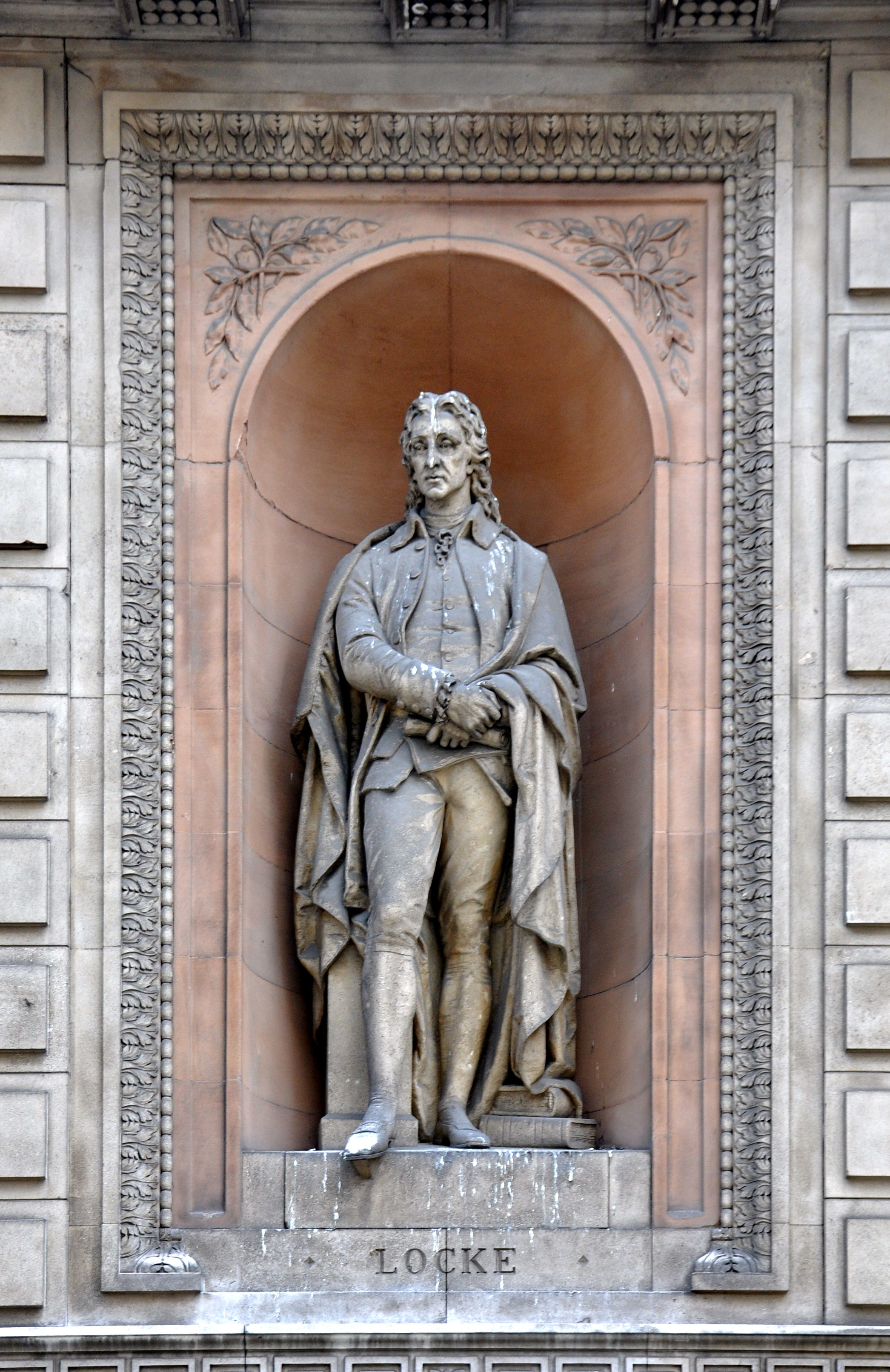
Classical liberalism is the view that individuals are prior to the State. On this view, individuals have three natural rights which are: life, liberty, and estate. The individual has a natural right to live once he begins to live; he has a right to do anything he wants as long as he doesn't violate the first right; and he has a right to to own all he creates or gains through gift or trade as long as these things don't conflict with the first two rights. The State is instituted to make laws protecting the individual's three natural rights. So, first we have the individual, then the State. The State (or government) is formed by the individuals to protect the natural rights of the individuals. This view was formulated by a 17th century political philosopher known as John Locke.
There are critics of natural rights. One such critic, J. Bentham, writes in his book Anarchical Fallacies that natural right theory “is from beginning to end so
much flat assertion: it lays down as a fundamental and inviolable
principle whatever is in dispute.” 1 Marx criticized natural rights for its focus on the individual instead of the community or "collective." He loathed the idea of man being isolated from others, pursuing self-interest rather than the interest of the whole. Marx thought of the individual as an, “isolated
monad… withdrawn behind his private interests and whims and
separated from the community.” (Marx 1844, 146) 2 Marx was not fond of natural rights or individualism. He thought natural rights philosophy made man selfish, that it divides people (the differences in talent will emerge - showing we aren't equal in talent), and that it engineers a capitalist machine. Many others deride the natural rights theory for not having a proper anchor and then go on to say that we should throw away this idea that man is an individual with inalienable rights such as life, liberty, and estate; opting instead for a society or state based political philosophy that places the individual after the State and makes him sacrifice his private interests for the public good. The latter levels everything causing people to be "equal," i.e. making everyone equal on the lowest common denominator (I'm not going to dive very deep into this position in this post - I'll wait until another post), which isn't equality at all.
So, how are natural rights anchored? Natural rights are anchored in natural law, so natural law is over natural rights. This is a big deal here. Some argue for natural rights, but not natural law (Hobbes) while others argue for both working together (Locke). The difference between Hobbes and Locke is that Hobbes argued for the freedom of the individual to do as he wishes without limitation, whereas Locke argued for the freedom of the individual to do as he wishes within the bounds of the law of nature. Hobbes's position that man is free to do as he wishes without restraint left man with no duty to respect the rights of others, which leads to a state of war. Who or what stops Hobbes's state of war? The Leviathan or as we know it today Big Government. On Locke's view there is a natural law that is binding on man to respect the natural rights of other men.Locke traces this duty to natural law.3
Locke speaks of this law of nature that is binding on us, but where is it? How do we know it? I don't see it anywhere. It's not hanging on the back of car bumper. I don't see it getting on the bus at the bus stop or eating in a restaurant somewhere. How can I access this natural law? With reason. We are born, those of us who aren't seriously mentally handicapped, with rational faculties enabling us to "access" natural law. Two things to remember about this view: The precepts of the natural law are binding by nature and the precepts of the natural law are also knowable by nature or reason. We know the truths of life, liberty, and estate innately; these truths are stamped on our minds and we know these things are ours by natural right. So natural rights are anchored in man's nature. We know these things naturally. We don't learn of natural rights through sense experience, we know of our natural rights before experience. This gets into rationalism and foundationalism, e.g. we know some truths prior to experience like there is a past and that there are foundational principles to knowledge (law of non-contradiction, excluded middle, etc.) which we use to know more truths. 4
Life, liberty, and estate are natural rights of man. "We know these truths to be self-evident..." Freedom rests on these natural rights. They are ours. We are born with these rights, but they can be given away or taken away. Locke believed that if these rights are no longer protected by the government, the very government the people created to protect their rights, then the people have the natural right to revolution against the government. He wrote, "Whensoever therefore the legislative shall transgress this
fundamental rule of society; and either by ambition, fear, folly or
corruption, endeavour to grasp themselves, or put into the hands of any
other, an absolute power over the lives, liberties, and estates of the
people; by this breach of trust they forfeit the power the people had
put into their hands for quite contrary ends, and it devolves to the
people, who have a right to resume their original liberty, and, by the
establishment of a new legislative, (such as they shall think fit)
provide for their own safety and security, which is the end for which
they are in society."
5
There is much more I could write about in this post like those who hate the natural freedom of man; that man must, by force of the State, eradicate his selfish interests for the common good of others, i.e. the State. I think it's for those reasons previously mentioned that some people don't think natural rights are actually anchored in anything at all and instead we are just selfish brutes who don't want to help anybody except ourselves (totally untrue). Natural rights and law are properly anchored in nature. If one is theist, one could even go one more step and reason that God has made us in His image; He is a free being; therefore we are naturally free. Even if you're not a theist, natural right and law are properly anchored in nature and it's a self-evident truth.
Check out my overview of collectivist philosophy
here.
Sources
1. Bentham, J., 1796, Anarchical Fallacies, in Waldron
1987a, pg. 66
2. Marx, K., 1844, “On the Jewish Question”; reprint in Waldron 1987a, pg. 146
3. These arguments are found in paragraphs 6 and 7, Chapter Two of the
Second Treatise of Government, and Chapter 5.
4. While I understand foundationalism and rationalism, I think if I attempted a detailed explanation I would butcher both. For
foundationalism click here and
for rationalism click here.
5. John Locke
, Second Treatise of Civil Government, Ch. 19, pg. 222
 Well, I consider a fetus a human being. It has done no harm, nor has
it committed a crime punishable by death. More important, I don't like
it when governments start getting clever about who counts as full human
beings and who doesn't (See: Slavery, U.S., or Holocaust, Nazi).
Well, I consider a fetus a human being. It has done no harm, nor has
it committed a crime punishable by death. More important, I don't like
it when governments start getting clever about who counts as full human
beings and who doesn't (See: Slavery, U.S., or Holocaust, Nazi).